The Next Luxury Amenity Isn't a Bar
How the $6.8 Trillion Wellness Economy Is Reshaping Hospitality, Commercial Real Estate, and What Premium Guests Actually Want
There is a shift happening inside luxury hospitality and commercial real estate that most operators have not fully priced into their amenity strategy yet. It is not a trend. It is a restructuring — of consumer values, spending behavior, and what premium guests define as status.
The short version: the next luxury amenity is not another bar, another nightclub concept, or another bottle-service lounge.
It is recovery, longevity, sleep optimization, diagnostics, performance, and social wellness.
The Numbers Are Not Subtle
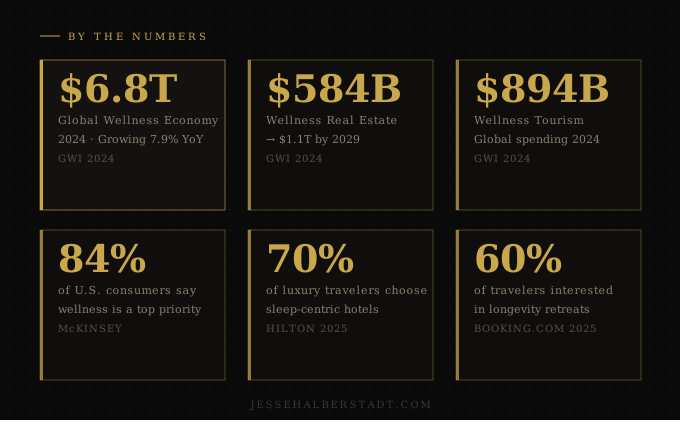
The global wellness economy hit $6.8 trillion in 2024 — growing 7.9% year-over-year and doubling in size since 2013. This is not a niche category competing for a slice of the hospitality pie. This is the economy.
Wellness real estate specifically reached $584 billion in 2024 and is projected to hit $1.1 trillion by 2029, growing roughly 20% annually over the last five years. That trajectory puts it among the fastest-growing segments in all of commercial real estate.
Wellness tourism — guests who travel specifically for health, recovery, longevity, or performance purposes — generated $894 billion in spending in 2024. McKinsey puts total U.S. wellness spending at over $500 billion annually, with 84% of U.S. consumers saying wellness is a top or important priority in their lives.
These are not yoga retreat numbers. This is a fundamental reallocation of premium consumer spending.
What Hotel Operators Need to Hear Right Now
Hilton's 2025 Trends Report found that 70% of luxury travelers choose hotels specifically based on sleep-centric amenities — wellness rooms, sleep programming, recovery-oriented design. More than 1 in 4 travelers would book a spa or wellness treatment on vacation specifically to improve their sleep quality.
Booking.com's 2025 research found 60% of travelers are now interested in longevity retreats. That figure — sixty percent — signals that health-span travel has crossed from early adopter into mainstream hospitality demand.
The longevity clinic market is projected to grow from $5.35 billion in 2025 to $6.02 billion in 2026, a 12.5% CAGR driven by preventive healthcare, personalized wellness protocols, and regenerative medicine.
The guest paying premium rates for your property is increasingly the same guest scheduling IV therapy, tracking biomarkers, prioritizing sleep scores, and choosing where to stay based on what their body can do there — not just what their night can look like.
The Alcohol Shift Is Real and It Is Structural
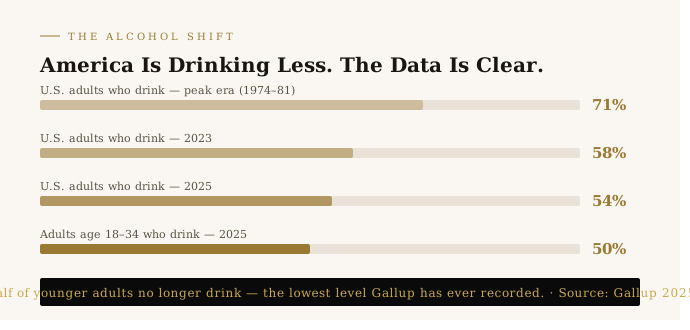
Gallup reported in 2025 that only 54% of U.S. adults say they drink alcohol — the lowest level Gallup has ever measured. During the 1974–1981 period, that number ran between 68% and 71%.
Among adults ages 18 to 34, only 50% now drink — down from 59% in 2023. That is a nine-point decline in two years among the most aggressively targeted demographic in hospitality.
Global spirits sales fell 2% in 2024. Brands across every major category are pivoting to premium, low-alcohol, and no-alcohol SKUs because that is where consumer intent is moving.
This does not mean the bar is dead. It means the bar is no longer enough — and an amenity stack built entirely around alcohol-forward programming is increasingly misaligned with where premium guest spending and preference is heading.
The mocktail bar is not optional decor. For the right property, it is a revenue center.
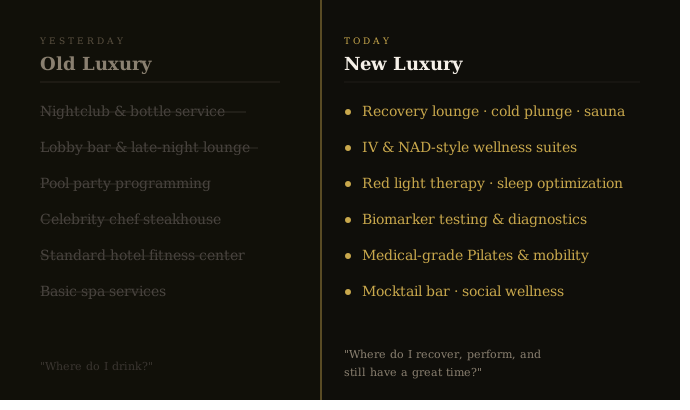 Old Luxury vs. New Luxury: The Amenity Stack Is Changing
Yesterday's luxury amenity package looked like this: Nightclub and bottle service. Lobby bar and late-night lounge. Pool party programming. Celebrity chef steakhouse. Standard hotel fitness center. Basic spa treatments.
Today's luxury amenity package looks like this: Recovery lounge with cold plunge and sauna. IV and NAD-style wellness suites. Red light therapy and sleep optimization rooms. Biomarker testing and longevity diagnostics. Medical-grade Pilates and mobility studios. Mocktail bar and social wellness programming. Breathwork and meditation.
The opportunity for hotel operators, mixed-use developers, and amenity planners is not to choose one over the other. It is to rebalance. The premium guest of 2025 still wants to socialize, eat well, and enjoy their stay. They have simply expanded their definition of what enjoying a stay means.
The Commercial Real Estate Translation
For developers, the framing is straightforward:
Wellness is no longer a tenant category. It is an NOI strategy.
Properties that integrate wellness-forward amenities are creating compounding competitive advantages: higher ADR and RevPAR potential, stronger residential premiums in mixed-use towers, deeper lease demand from a creditworthy and fast-growing operator category, and a more future-proof tenant mix that is less vulnerable to the next economic cycle.
The wellness demand wave is not cyclical. It is driven by demographics, the cost of reactive healthcare, advances in longevity science, and a generational redefinition of what aspirational living looks like. These are durable structural tailwinds — not a moment that passes when the economy softens.
The Question Worth Asking
The modern luxury guest is not just asking, "Where do I drink?"
They are asking: "Where do I recover? Where do I sleep better, look better, live longer, perform better — and still have a great time doing it?"
For hotel operators, that question is a product development signal.
For developers with vacant amenity floors, underperforming spa concepts, or nightlife-anchored programming that no longer resonates the way it once did — it is something more urgent than that.
It is a window. And the operators who move first will not just fill space. They will redefine what their property stands for.
Jesse Halberstadt is a commercial real estate broker with Coldwell Banker Commercial Premier in Las Vegas, specializing in hospitality investments, luxury mixed-use development, and amenity repositioning strategy.
702-557-0609 · [email protected] · jessehalberstadt.com